
Submitted by Joanna Lumbsden-Pinto, Ph.D.
On April 26, 2025, a small group of students gathered around a table for what would become the first “Peace Feast,” an interfaith initiative designed to cultivate friendship, trust, and meaningful dialogue between Christian and Muslim students at Syracuse University and SUNY-ESF.
Peace Feast was envisioned as a sacred space — one where students could speak openly about their faith, listen deeply to one another’s stories, and build relationships grounded in mutual respect.
The Graduate Christian Fellowship and the Muslim Student Association at SU launched a three-part series at the close of the 2025 spring semester, bringing students together over shared meals and guided conversation.
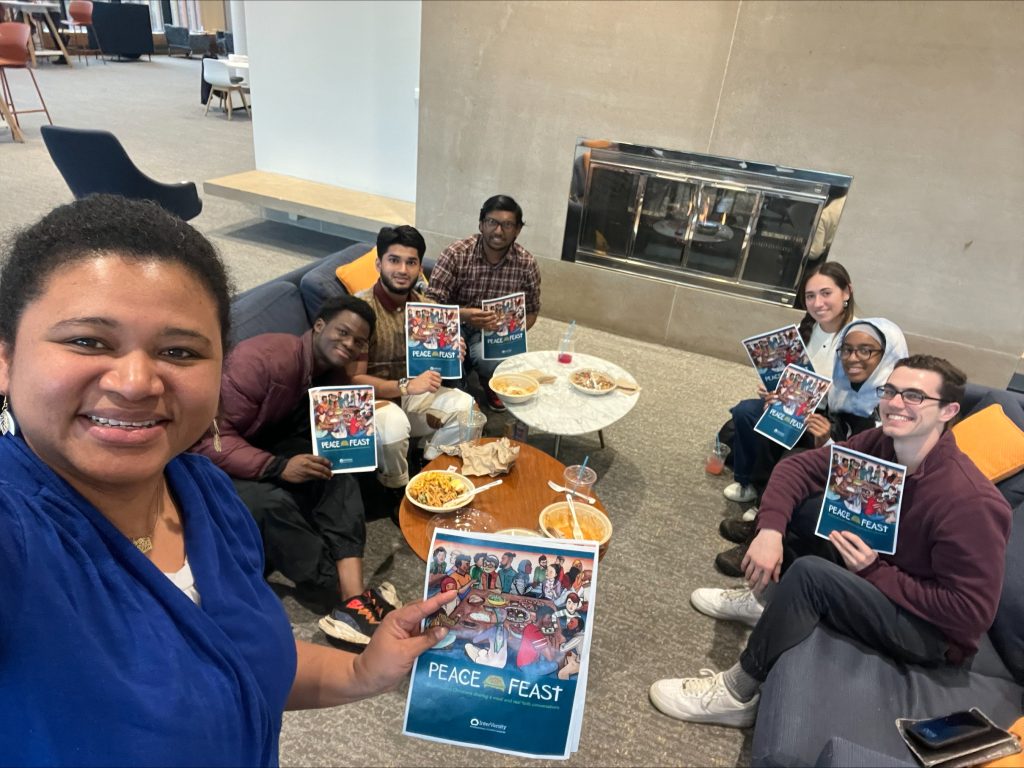
“It was very nice hearing everyone’s stories today,” shared ESF student Ava Wiggins after the first gathering. “Thanks again for being vulnerable and respectful today.” Safety and openness became a defining feature of the Peace Feast experience.
“Thank you all for being able to navigate through a sensitive discussion and creating a safe space for all of us to share,” reflected Mian Hamid ’25 G’26, convener of the Student Assembly of Interfaith Leaders.
Students expressed that learning about one another’s faith practices was both eye-opening and enriching. Participants Teddy Caputo G’25 and Paola Mendez G’25 shared that learning about Islamic customs from their peers broadened their understanding in meaningful ways.
Moments of shared recognition also surfaced. During one discussion, Allen Jeriel G’26, a Christian student, and Schneider Joachim ’26, a Muslim student, reflected on how life’s hardships often shape one’s relationship with God — revealing both the distinctiveness of each tradition and a shared human longing to connect with the Divine.
The dialogue continued into the summer through a “Shared Prophets” study series. On August 21, 2025, students concluded conversations exploring figures honored in both the Bible and the Qur’an, including Adam (Adam), Noah (Nuh), Abraham (Ibrahim), Moses (Musa), and Jesus (Isa).
These sessions sparked rich discussions around divine calling, obedience to God, and moral responsibility (or haram), as understood in Islamic teaching. For many participants, the experience deepened their understanding of both their own faith and that of their neighbors.
While the first Peace Feast gathering was intentionally intimate, organizers hope to expand the initiative in the future, continuing to center Muslim and Christian student participation while welcoming a larger group into the conversation.
Beyond the formal gatherings, the long-term impact has been found in everyday campus life; in the warm smiles exchanged across the Quad and the ease of greeting one another not as strangers of different faiths, but as fellow graduate students navigating the same academic pressures. These friendships, formed through shared vulnerability, have promoted a deeper recognition that while beliefs differ, the search for hope, meaning, and faith remains a powerful common ground.
As organizers look ahead, the hope is to expand Peace Feast while preserving the intimacy that made the first gatherings so meaningful. What began as a simple shared meal has grown into an enduring model for interfaith connection; one grounded not in debate — but in an invitation to listen well, to share courageously, and to continue cultivating peace across faith traditions on campus.
Joanna Lumbsden-Pinto is a member of the Graduate Christian Fellowship and is a fellow with the Fellowship of Emerging Leaders in Ministry.